
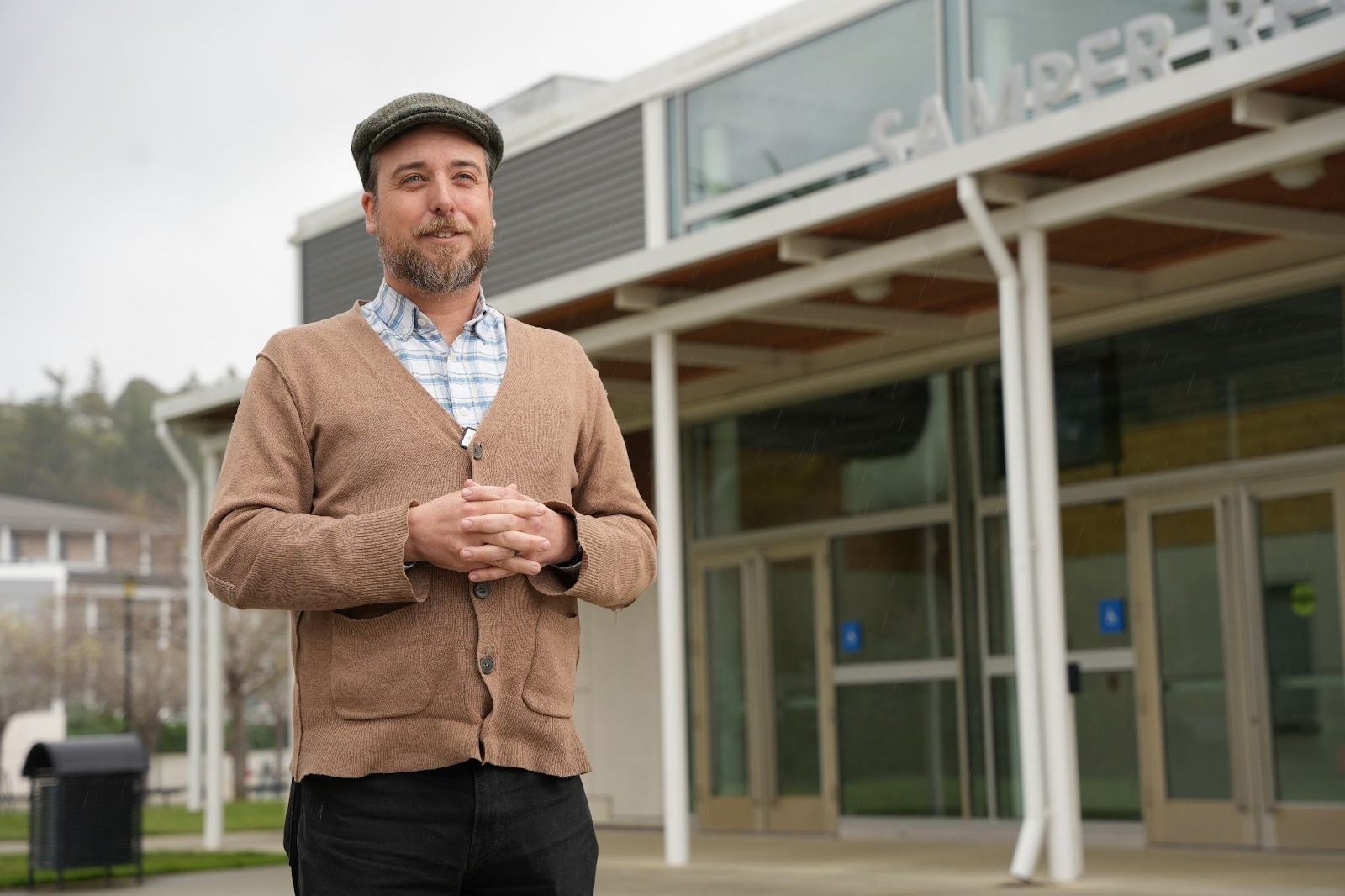
On paper, Sean Dougherty’s campaign for Congress reads like Monterey Bay’s own David-and-Goliath story. He seeks to unseat Jimmy Panetta, a five-term incumbent whose family has been a pillar of local politics since the 1970s.
Moreover, Panetta already defeated Dougherty once – and by a significant margin. When the two first faced off in 2024, Panetta walked away with a staggering 65% of the vote, and Dougherty with only 6% (a Republican candidate received the remaining 29%). For Dougherty, the landslide loss only reaffirmed the need to challenge Panetta and the status quo he represents.
“The short of it is that I don’t think [Panetta] listens to his constituents,” said Dougherty. “The Israel lobby is his top donor…Since October 7th [2023], he’s voted for every dollar of military aid that’s been sent to Israel. And most of us in this district, most Americans at this point are absolutely horrified by what Israel has done to the people living in Gaza and the West Bank. But he doesn’t seem to hear us at all.”
The Santa Cruz native had grown dissatisfied with Panetta not as his competitor, but as a constituent of California District 19, which Panetta has represented for nearly ten years (the district includes the entire coastline of Monterey Bay – western Monterey County, excluding Salinas and parts of Watsonville, and all of Santa Cruz County). Yet after Dougherty’s defeat in 2024, he had to acknowledge that a change of tactics was required.
In 2024, Panetta was the Democratic Party’s uncontested nominee; Dougherty ran as a candidate for the Green Party, a left-leaning third party based around grassroots organizing that he says still aligns best with his values. This time around, Dougherty will be on the ballot as a Democrat – a largely unplanned move that has earned sharp criticism from Green Party loyalists. He made the decision after a progressive Democrat announced candidacy just two days before the filing deadline.
“He was going to be splitting the anti-war progressive lane with me, which would have made it impossible to have a November ballot that was anything other than Panetta versus a Republican. So I said, okay, what if I switch to the Democratic Party? Because I told him, we can’t split the vote…So I switched to Democrat, and he dropped out. That was the compromise,” said Dougherty. “I’d say overall, most Greens can understand what I did. Some hate me…but I think if those Greens saw me get into office and continue calling out corruption, regardless of party…I think they’d say, ‘Cool. I support you. Maybe there can be a good Democrat.’”
Dougherty left the Democratic Party in 2020 in response to their rejection of Bernie Sanders. While he’s agreed to identify with them for the purposes of this year’s election, he hopes implementation of a ranked choice voting system will make elections more accessible to third parties in the future.
He also believes that Democrats have a lot to learn from the Greens – a party composed mostly of leftists disillusioned with the Democratic establishment. Dougherty’s campaign slogan is “for the many, not the money”; his top priority is eliminating corporate influence in politics. If elected, he aims to push for major institutional changes within the Democratic Party, to the tune of strict corporate donation limits and other Green-inspired ideals.
Perhaps his most ambitious goal is a constitutional amendment overturning Citizens United v. Federal Election Commission (FEC). Citizens United v. FEC was a 2010 Supreme Court decision that deemed political donations by corporations to be free speech, protected under the First Amendment. Laws limiting those donations were therefore unconstitutional and illegal.
While constitutional amendments are protected from presidential vetoes, they require two-thirds majority support in both the House and the Senate. That may currently seem like a long shot, considering Republican majorities and the idea’s lukewarm reception among Democrats. Dougherty, however, believes it could be possible if progressive values become more normalized within the Democratic Party.
Another priority of his is abolishing Immigrations and Customs Enforcement (ICE) – formed in 2003 and granted sweeping authority in response to the events of September 11, 2001. About 76% of nationwide Democrats agree with him, according to a January YouGov poll.
Panetta, meanwhile, has a complex and controversial history when it comes to ICE. He joined the majority of Democrats calling for reforms in response to the Minneapolis shootings in January. He’s also advocated for greater enforcement along the border in order to curb immigration, and even voted in favor of a resolution thanking ICE for “protecting the homeland” after an attack on an Israeli hostage solidarity march killed one and injured 13 in Colorado last summer (It was local police, not ICE, that responded and arrested the perpetrator, an Egyptian national).
“[Panetta] wants to take a more reformist approach, give them body cameras, give them better training, and I like to refute that by pointing out that the agent that shot Renee Good in the face recorded it on his own phone. So a body camera wouldn’t have made a difference,” said Dougherty. “And he’d been with ICE for about a decade, and was a team lead and was actually training other people. So I think people like Panetta or the establishment Dems or the Republicans want us to believe that that was just a fluke. It was just because he was one of the goons that came on during the second Trump administration, but that’s just not the case, right?”
A self-proclaimed idealist, Dougherty acknowledges that some might find his policy proposals unrealistic, despite high support from Democratic voters. He says that electing progressive candidates like himself will help close the gap between the actions of politicians and the will of the people they represent.
“We have to get out and vote for the people that hold these opinions, and we have to stop saying, ‘oh, well, someone who holds these opinions can’t win, so let’s not even bother,” he said. “So, I mean, it sounds so cliche, but you gotta vote. You’ve got to vote.”