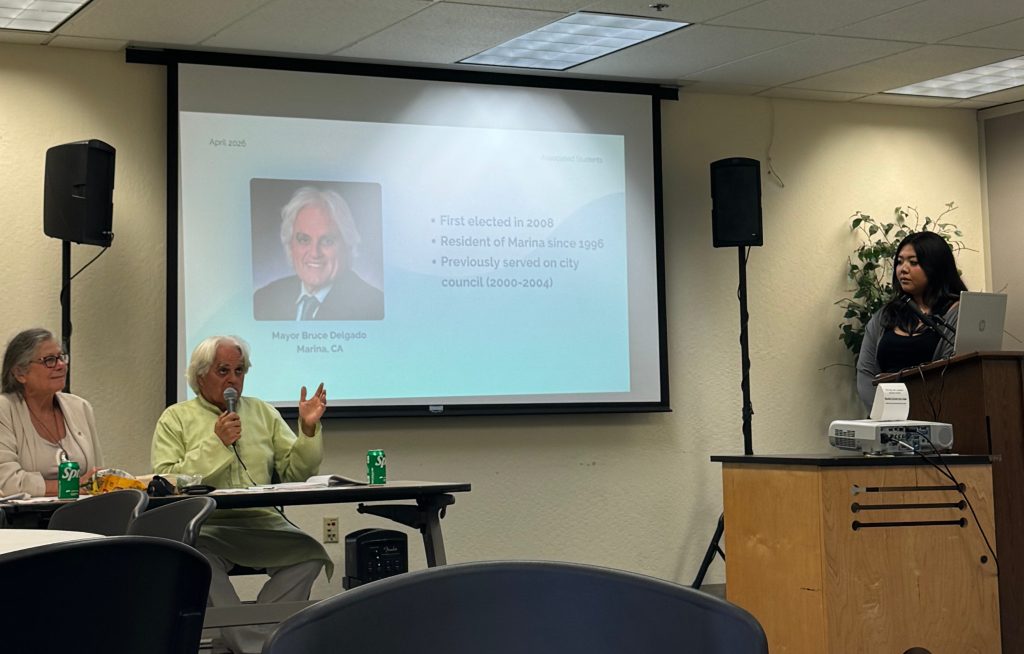
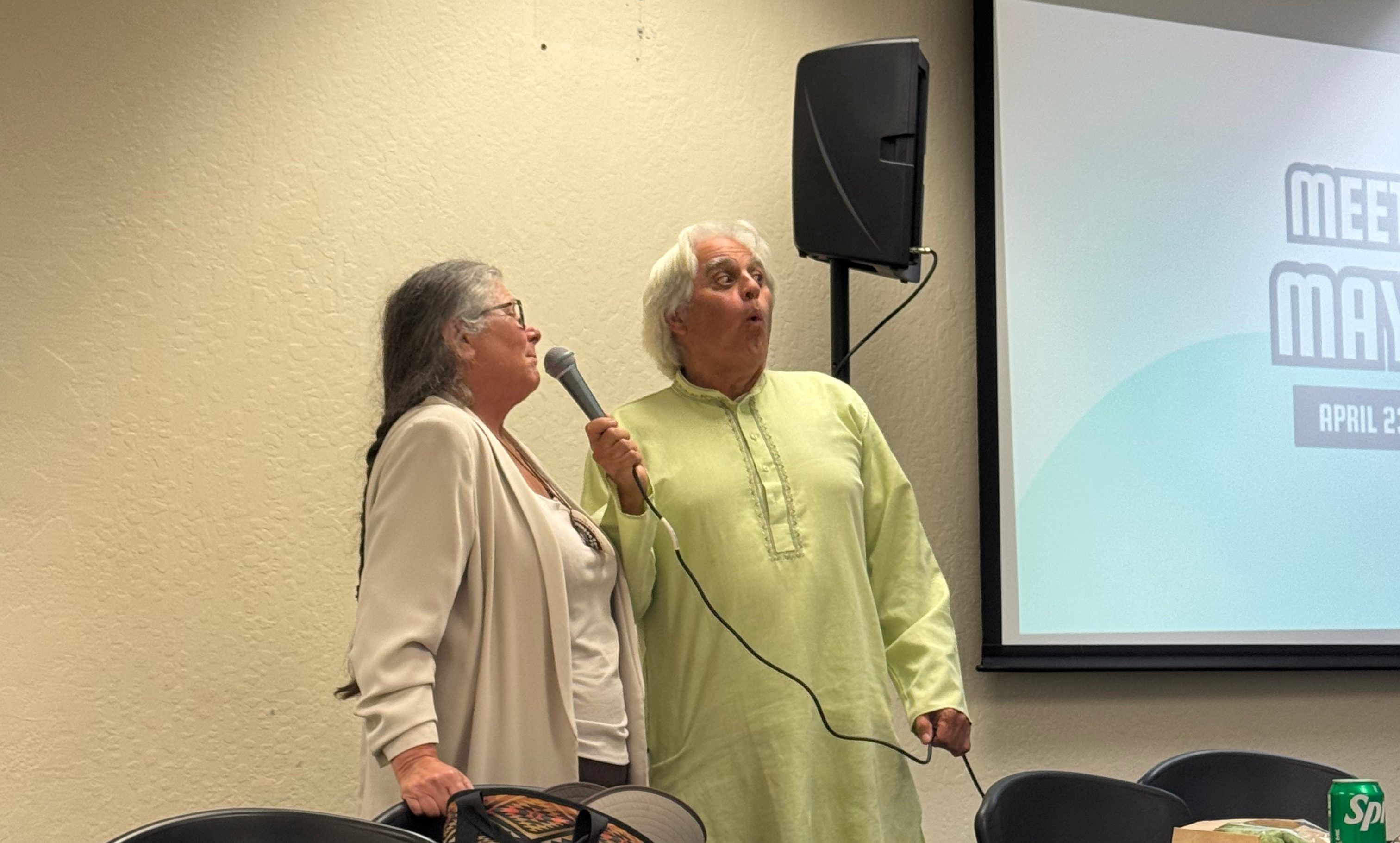
Mayors Bruce Delgado and Mary Ann Carbone seemed more like close friends than coworkers when they addressed about a dozen students, staff and community members at the Student Center Thursday afternoon.
Delgado and Carbone had taken a break from their duties governing Marina and Sand City, respectively, to attend Meet the Mayors, an event hosted by Associated Students (AS) to connect Cal State Monterey Bay (CSUMB) with the world of local politics. Seaside mayor Ian Oglesby had also been slated to attend, but cancelled due to a scheduling conflict.
The two mayors were casual and comfortable in each others’ company, most obviously in the minutes before the event began; Carbone laughed and rolled her eyes as Delgado jokingly grilled her about President Trump. Yet when emcee Gaby Weedon, a fourth-year sociology major and AS vice president of external affairs, asked them to introduce themselves, they quickly made it clear how seriously they took the event – and the students who attended.
“I appreciate people like Gaby and Thorn [Perez, AS vice president of internal affairs], you step up to be, you know, official here in the university,” said Delgado. “But they need support and can’t do a lot by themselves. They need the student body…so thanks to everyone who showed up here.”
A Q&A session took up most of the event’s two-hours. Both mayors confronted housing affordability, a complex and especially impactful issue for students living off campus.
“The city of Marina, and every city, has to balance building affordable housing…[with] being able to collect enough revenue to keep everybody safe with parks and regulation programs and fire and police,” said Delgado. “And so the cities are usually thankful to have more expensive homes as part of the mix, because they generate more property tax.”
In this case, “part of the mix” may be an understatement. Both mayors shared that their cities require just 20% of units to be “affordable,” or accessible to low and moderate-income residents, in order to approve new housing projects. That presents a serious problem for the average resident.
Low and moderate income in Monterey County includes households making between $30,000 and $135,000 each year. Marina, meanwhile, has a median household income of $96,000 as of 2024; Sand City’s was even smaller at about $78,000.
If 80% of new housing developments are unaffordable for the average resident, how will the area accommodate its growing population – especially as enrollment continues to climb at CSUMB? The mayors pointed to Section 8, or the Housing Choice Voucher Program, which can pay 60-70% of rent and utilities for low income households. Yet they also expressed that in the long term, there may not be an easy answer.
“You want to make the town better, and then it becomes more expensive later because more people want to live there,” said Delgado. “That’s a real tough nut.”
The housing issue may be more pressing for Delgado. After all, Marina has a population of about 23,000, including many CSUMB students living both on and off campus. Sand City is comparatively tiny with about 330 residents. Yet what Sand City may lack in population, it seems determined to make up for in culture and community engagement.
Those efforts are particularly important to Carbone, who highlighted her Chumash heritage during the event. As the first indigenous female mayor in California history, she uses the city’s council chambers for events aimed at passing her culture onto the next generation.
“In my spare time, I am a culture bearer,” said Carbone. “To teach the culture to the younger generations so that they have that…it’s not really in the books.”
For Carbone, bearing the culture means teaching her community to make indigenous regalia, clothing and recipes. It also means bringing attention to the ongoing crisis of missing and murdered indigenous women in the U.S. – particularly in California, which she described as “one of the largest states for the trafficking of indigenous persons.”
On May 2, Carbone is hosting a candlelight gathering and reception at the Sand City council chambers in honor of missing and murdered indigenous persons. She passed out flyers for that gathering during the Thursday event, which overlapped with a protest of anti-Black racism outside the Otter Student Union.
“It’s time for the people to unite, red, brown and black,” said Carbone, “for the treatment of racism here in our country and in our community.”