
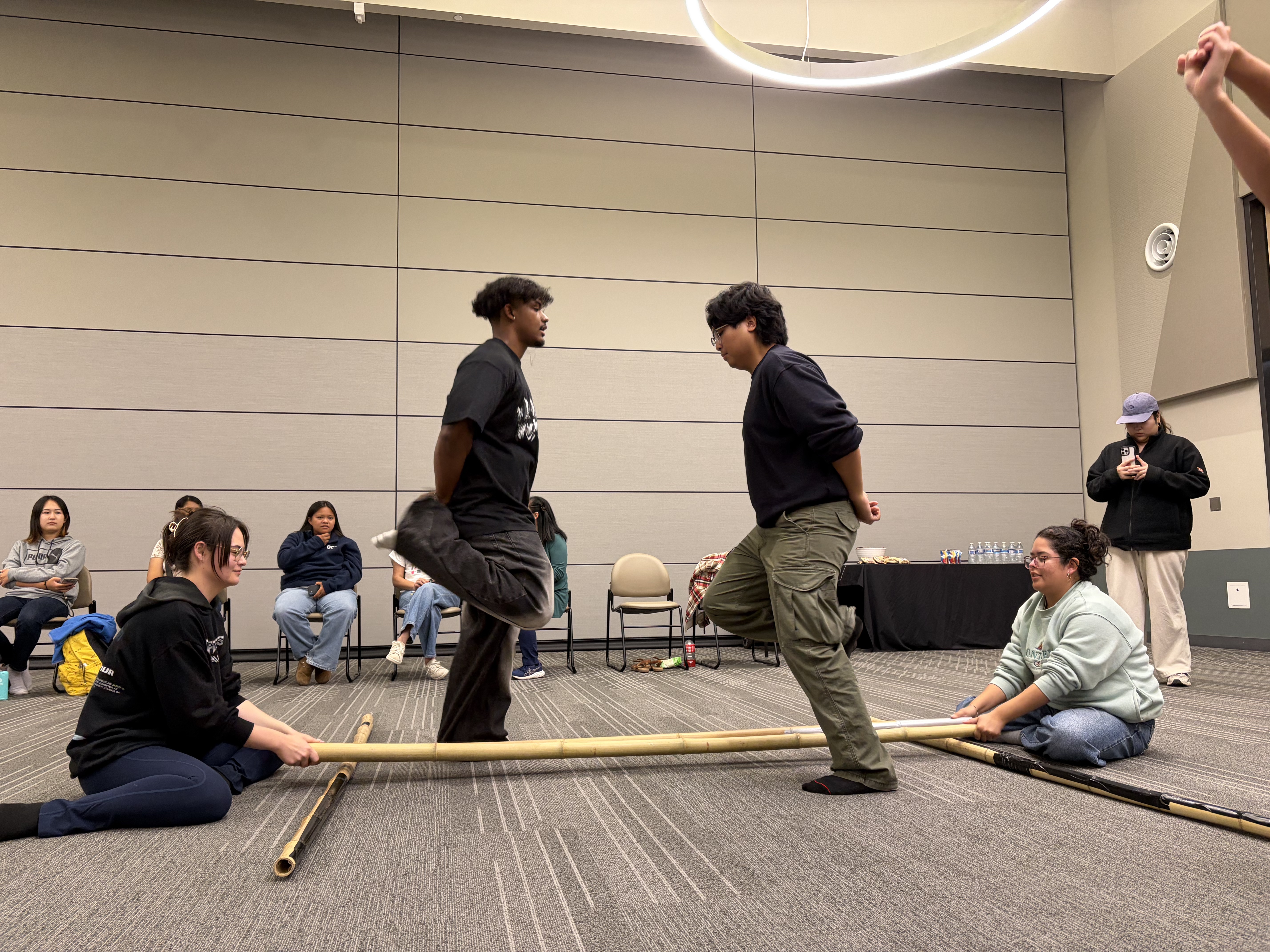
To commemorate Filipino American History Month, 24 students were taught the Filipino folk dance called Tinikling last week in the Otter Student Union ballroom.
Tinikling is a traditional dance from the Philippines that involves two people holding the ends of thick bamboo poles, clapping rhythmically, as dancers maneuver in and out.
To host this workshop, three campus groups collaborated: the Otter Cross Cultural Center, the Asian Pacific Islander Association and the Asian Pacific Islander Desi American Center.
Within the ballroom, four Tinikling stations were set up and led by student coordinators and volunteer dance instructors. In groups of four, they taught the basic steps and rhythm of the dance alongside the cultural song played by a rondalla, or an ensemble of string instruments.
One of the student coordinators, Jon Abundis, explained how the purpose behind this event was to showcase Filipino dancing culture and to bring together a welcoming atmosphere for anyone curious about it.
“I feel like it’s important because not many people know too much about the history of the Philippines and Filipino culture in general,” said the liberal studies sophomore. “So by us having Filipino American History Month, we get to show and talk about their culture, history, their struggles and most importantly, their resilience.”
This note on resilience also resonated with the event’s dance instructors, who viewed teaching this traditional dance as a way to stay connected to that heritage. “Growing up there was such a strong importance of remembering where you came from,” said Jeramiah Bartolome, the co-president of the Asian Pacific Islander Association. “My values of family in general had been really pushed on to me so I’m very appreciative of where I come from and I try to be educated in some kind of matter, in order to tell future people about it.”
Another dance instructor, Kyan Lee, also shared similar thoughts. “I think a lot of Filipinos that I know aren’t super connected with their culture back home. And I think having things like Filipino Heritage Month and events like these, just really help people reconnect with some things that may have been lost being second or third generation immigrants.”
Throughout the workshop, students of all different levels and experiences were encouraged to participate. With guidance from people like Lee and Bartolome and building trust with the members of their group, students were able to coordinate their movements with the clapping of the bamboo poles.
Dion Barra, one of the participants, said he previously learned Tinikling in high school and attended the event to reconnect with Asian Pacific Islander Association club members after a friend recommended it. “It’s just super cool seeing people of different levels as well learning all the same things. It’s a very nice collaborative dance,” said the communication design junior.
“You really have to be connected with one another to dance. I think that’s really beautiful, honestly. And from my experience, Filipino culture is a very tight-knit community with close families. So I think that this dance shows a part of that culture.”