
To kick off Hispanic Heritage Month, Cal State Monterey Bay held Hispanic Serving Institution Week from Sept 14-19.
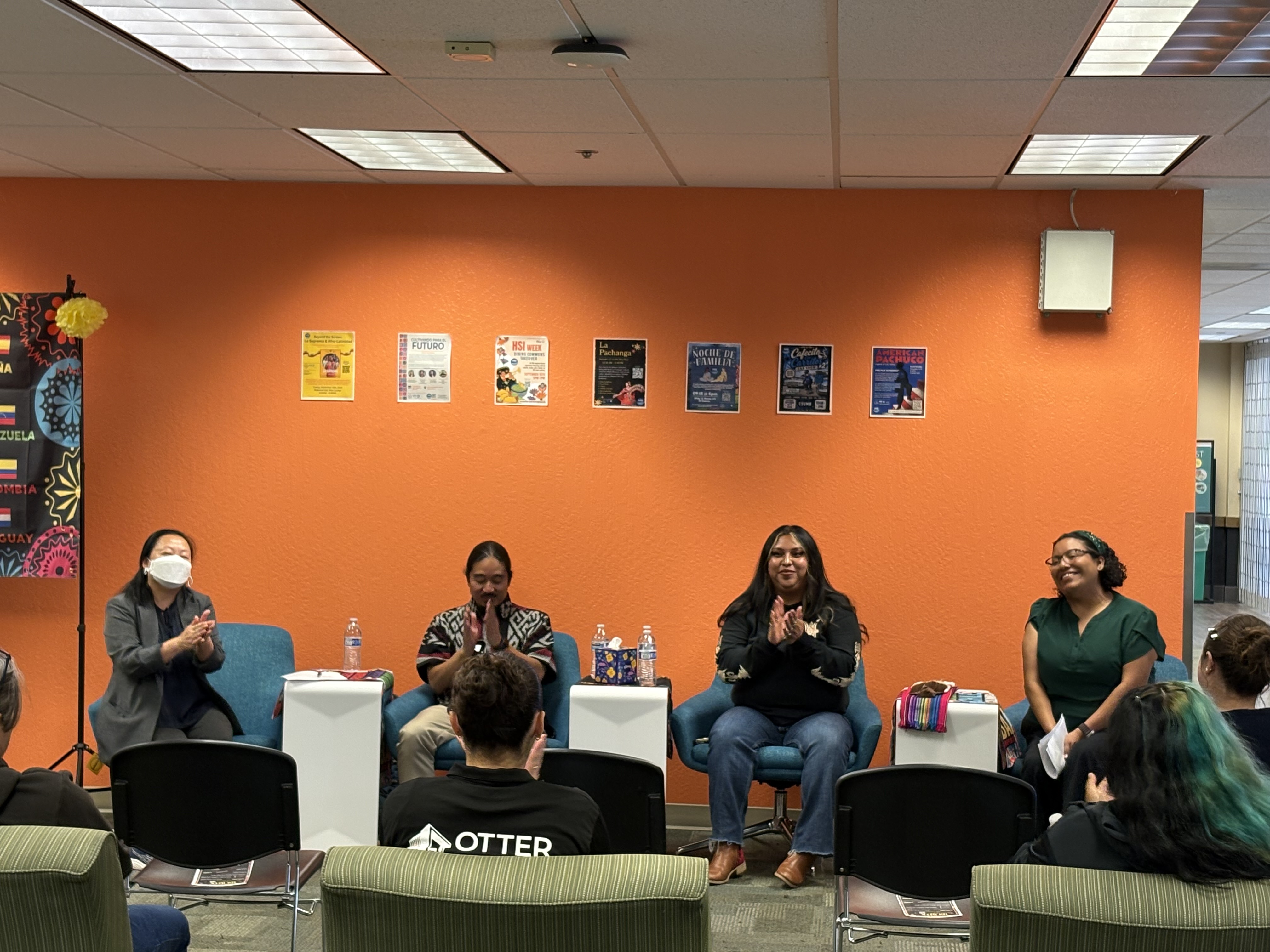
On Sept 15, over 20 attendees joined El Centro and the Asian Pacific Islander Desi American Center as they held a joint panel in Redwood Hall. The centers invited panelists to discuss how intersectional identity meets education, advocacy and community work.
Panelists included Keylin Figueroa of Motivating Intergenerational Leadership for Public Advancement, and Jason Galinato Agpaoa from Asian Cultural Experience of Salinas, as well as the Filipino-American National Historical Society.
Figueroa and Agpaoa took attendees through their own journeys in understanding their intersectional identities.
“[I]t wasn’t up until this year that I was like… I’m from here and I am from there, right?” said Figueroa.
“I’m [really] proud to be Chicana Indigenous and I’m [really] proud to be Mexican-American, you know? It’s like the whole duality of what we get to live through.”
Agpaoa shares how being around the Mexican community in Salinas gave him a culture shock when moving to San Francisco for college and finding the Filipino community there. This provided him with insight on how to raise awareness to the Filipino community in Salinas.
“When I think of what it means to be Filipino, I think of [halo-halo] because it’s a mix of different things…What one halo-halo looks like is going to be different from another person’s halo-halo,” said Agpaoa.
A key takeaway Agpaoa and Figueroa stress is that students and staff should attend events to gain connections with communities.
“I feel like [these events] answer three essential ethnic studies questions. ‘Who am I?’ ‘Who’s my family and my community?’ And ‘what kind of change can I bring to my community?’” Agpaoa said.
“Understanding, answering those three questions, hopefully it kind of motivates and inspires folks to kind of find what change they want to bring to their community.”
The panel underlined the importance of intersectionality and joining the community around the area in order to connect with others and connect with oneself.
“We can survive alone. Look, we’re here, look at every single person here, right? But to thrive, we need each other.” Figueroa said.