
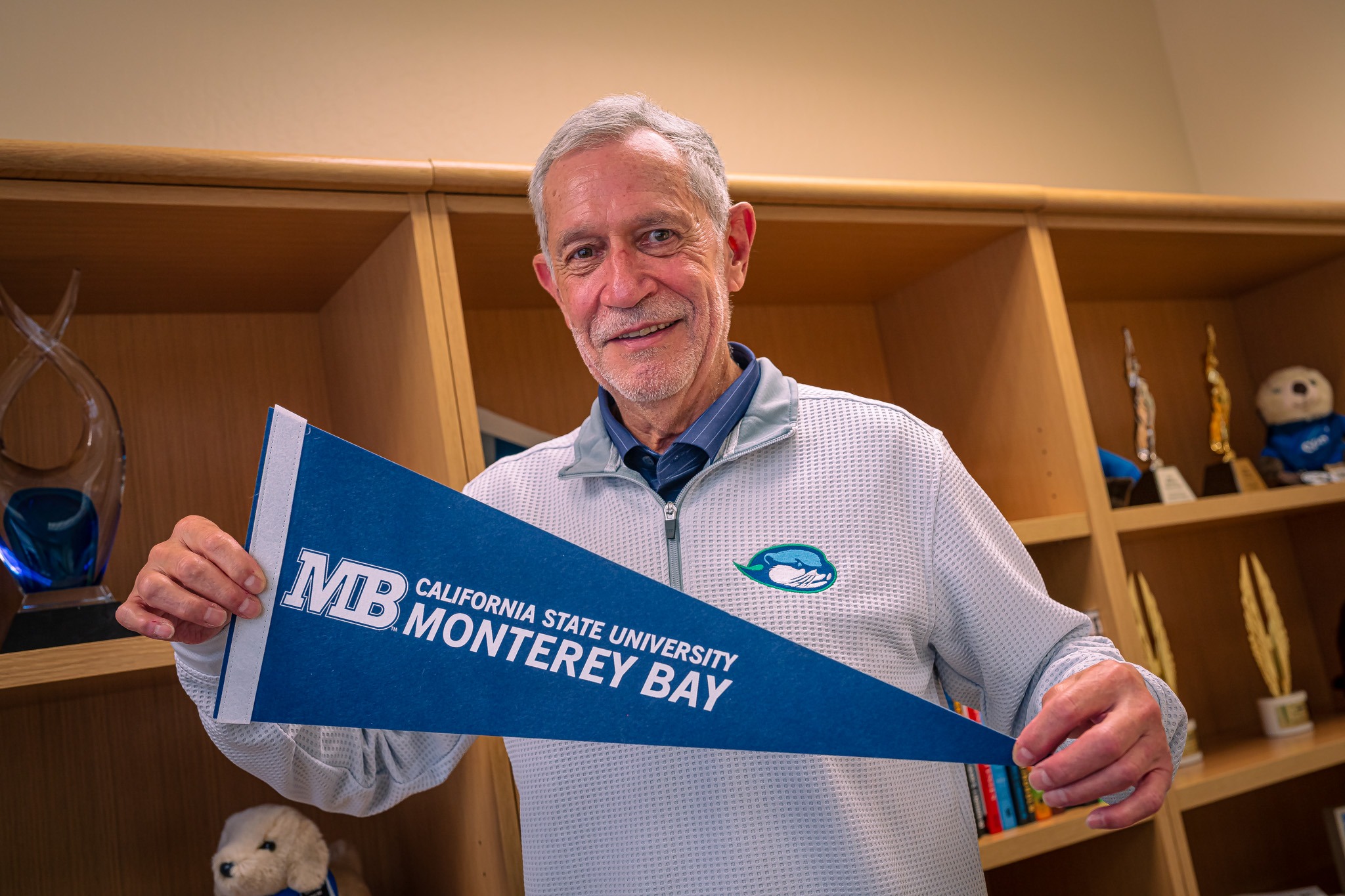
Carlos Vargas-Aburto has worn many hats throughout his career: professor, administrator and most recently, newly appointed interim president of Cal State Monterey Bay. He took a break from back-to-back meetings to sit down for an interview with the Lutrinae last week.
The 78-year-old veteran educator was brought on to lead the school as it searches for a permanent replacement for Vanya Quiñones, who moved on to Cal Poly Pomona at the end of the spring semester. He emphasized his desire to connect with students during his one-year term at CSUMB. Keep reading for Vargas-Aburto’s own words on everything from his personal background to AI to student financials.
Culture
Vargas-Aburto: I was originally born in Mexico. My family is from there. I was the first one to go to college and graduate. My family was very poor. We didn’t even own a home, and we moved around many times within the country.
What I have found [in Monterey] is a very warm welcome from people. It’s been very exciting to talk to people. Sometimes, they actually have roots in Mexico. When I talk to them, we find out that they have relatives in the same city where my mother was born, or my father was born. So it has become a very personal connection that I have, and I’m excited about talking and developing contact with those communities.
In Spanish we have a phrase: si se puede (yes we can). And that’s what I want to say to them. I see myself in so many of the students that walk around campus. I want them to recognize that I know that it is possible and to try to convey that to them. It’s just a matter of making an effort. You can’t expect things to happen if you don’t make an effort.
AI
Vargas-Aburto: That is something we need to tackle and help the students understand how they can utilize that new technology for their benefit…it’s one of those things that is changing the teaching and learning environment. We need to recognize that. I mean, I’ve used AI for some things. So the point is, how can I use AI to improve what I do?
What we need to do is help the students develop the ability to ask the right questions. Asking the right questions is important to getting the answer you need. Not just the simple, tell me what coffeemaker to buy. How can you really use AI to help you be more effective at learning, right? That’s what we need to do.
On-Campus Immigration Enforcement
Vargas-Aburto: That is a difficult question. And that’s one where I need to recognize the way that things operate within the CSU, which is that the lobbying and the interaction with the federal government, and even state government, is channeled mostly through the chancellor’s office and board of trustees.
I see myself providing, perhaps, help when the chancellor’s office needs something or wants some advice…But I’m not going to be the one speaking on behalf of the university in Monterey Bay.
Education and Work Experience
Vargas-Aburto: I went to college at the National University [of Mexico]…graduated with a bachelor’s degree in physics. I wanted to go and get my advanced degree somewhere – initially Germany, but then a friend of mine suggested we apply to the U.S. I was admitted to the University of Michigan, so I got my Ph.D. there in physics and aerospace science.
After that, I actually returned to Mexico for a few years, and then came back to Kent State University in Ohio as a faculty member. So I was there for 20-plus years, 18 years formally at the university, but I taught there for about 20 years. After being there, taking some leadership programs, I became provost at an HBCU (Historically Black College or University – Central State University) in Ohio.
I was there for about three years, then I took a position as provost at Kutztown University in Pennsylvania. I was there for eight years as provost, one year as acting president, and then I applied for the position of president at Southeast Missouri State University (a public university of about 10,000 students). I was there for 10 years.
Financial barriers
Vargas-Aburto: I have heard about some of the limitations that the students have in terms of, maybe their financial situation is difficult. In particular when I was at the HBCU, I ran into this situation many times.
I remember one time I was sitting with students who were having lunch in the president’s office…and one of the students said, well, it’s hard to do well in academics, because you’re receiving emails from the office of financial aid that are threatening, if you don’t make a payment, we’re gonna drop you from your classes, or you may not have enough resources to buy food. And he says, how can you concentrate on academics when you have these threats hanging over you, and you don’t see how you are going to deal with them?
I walk around campus remembering that all the time. So I don’t just go and say, you guys should sit down and study. No, you have to put that in context…you don’t know what fights they’re fighting. To me, it’s a crime not to recognize that, and not to be kind and understand that their performance is probably being affected by that.
Aspirations for the school year
Vargas-Aburto: Time is of the essence…technology is moving so fast. We need to not just give [the students] facts. We need to develop the ability to think, you know?
I’m gonna be here for a year. I don’t know how much impact I can have. But certainly, I want to be a bridge, so that the new president, when he or she comes, finds a better place. I had an aunt when I was little. When we visited her house, I’d go into the restroom, and she had a little sign that said, leave the bathroom better than you found it. I want to leave this university better than I found it.