
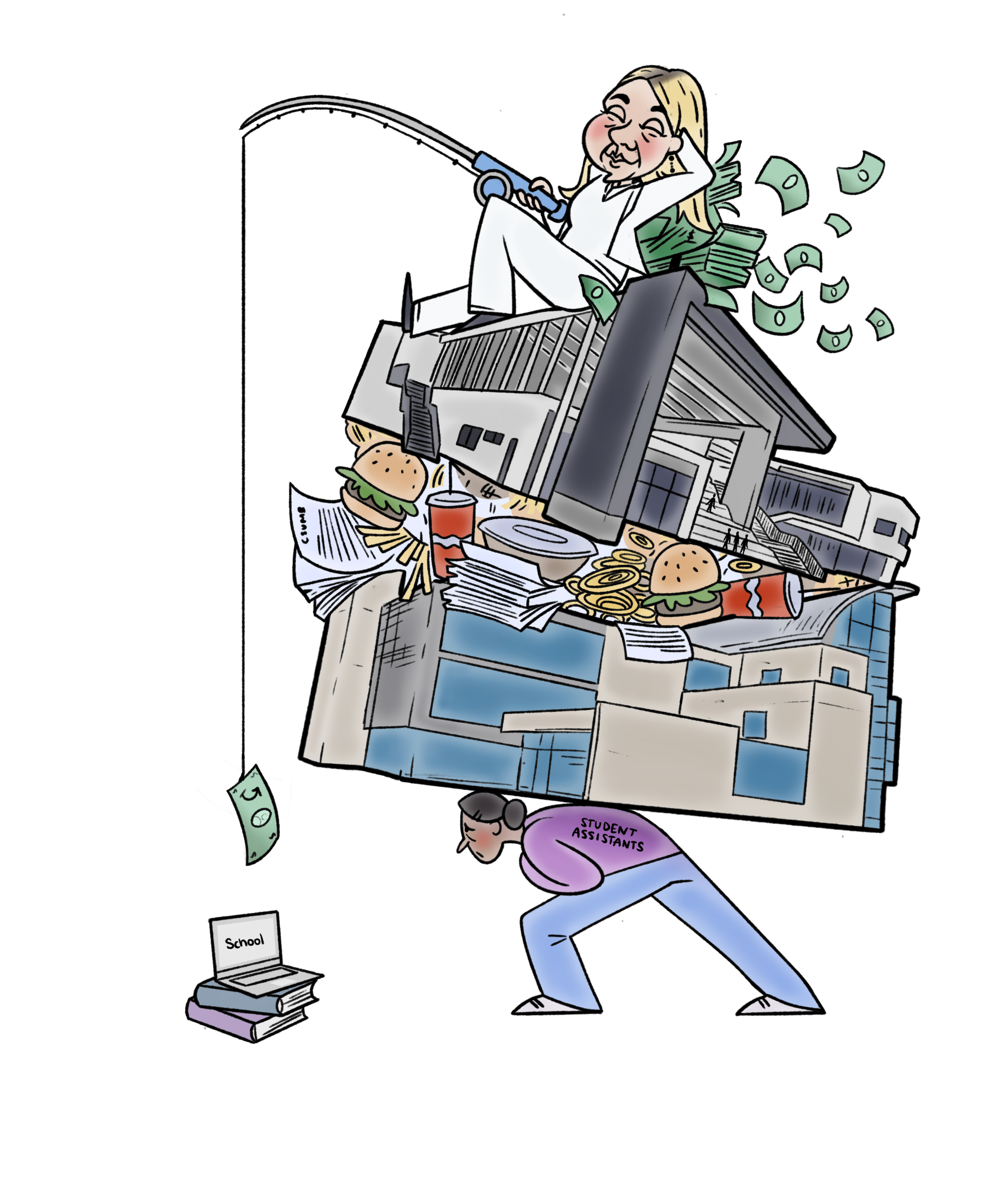
Student assistants are everywhere on campus. They stay late to close buildings, wake up early to prepare the dining commons and keep essential services running long after many offices close and pro staff go home. They are the students working until 10 p.m. to keep the Sports Center open, the students running the OSU from before sunrise to after sunset, the tour guides meeting hundreds of prospective students each week and the eight students in the Center for Academic Technologies converting thousands of documents, textbooks, and workbooks into ADA compliant formats to meet California Law.
Student assistants are the backbone of the university. Yet they are severely underpaid, overworked and often under-appreciated.
By law, universities are only required to pay student assistants minimum wage, and the university chooses to meet only that minimum. The result is a large portion of the California State University Monterey Bay workforce is made up of students who are paid the least possible amount for essential labor that keeps the campus running. For many students the experience of working simply to afford housing, food and tuition is not an unfamiliar one. This system leaves little room to refuse low pay or poor working conditions, because it’s all we have.
According to the CSU Student Assistant Classification and Qualification Standards, student assistant work can range from “unskilled” to highly specialized. But regardless of the skill level or work required, student assistants are not guaranteed pay beyond minimum wage.
Non-student employees performing similar or comparable work receive not only better wages but also far greater benefits and job protections. Professional staff positions at CSUMB include access to benefits such as health care, retirement plans and paid leave, resources that student assistants are excluded from. Student assistants, however, are limited to working 20 hours per week during the academic year and are paid only minimum wage. At that rate, a student working the maximum allowed hours, can only earn about $1,352 per month. Even if a student were able to work full-time while balancing classes, their monthly earnings would reach only about $2,929.
Across the CSU system, student assistants make up a significant portion of campus workers. Of the more than 450,000 students across 23 campuses, nearly 20,000 are classified as student assistants about 4.4% of the student population and between 25-32% of the total CSU workforce as a whole. Student assistants make up a massive unpaid, and underrepresented portion of the CSU’s workforce.
Student assistants are essential to keeping this university running, yet we are paid the bare minimum for work the campus depends on.
If the thousands of student assistants across the CSU or even the hundreds across this campus, stopped showing up tomorrow, dining halls would struggle to operate. Recreation centers would close, tours would stop and critical services across campus would slow or halt altogether. The university relies on student labor to function, but too often that reliance comes with the lowest possible pay and recognition.
If student assistants truly are the backbone of campus operations, then it’s time for universities to start treating us like it.
Editor’s note: The staff at the Lutrinae are considered student assistants and paid minimum wage, except for the editor-in-chief.