
Egg cartons, empty spaghetti jars and bottle caps are among things commonly thrown out to sit in the landfill, polluting the Earth after one use. However, Cal State Monterey Bay students are learning that those objects can have more than one life.
Derek Martin, associate director of the Safety, Risk, and Sustainability office at CSUMB, and Carolyn Gonzalez, associate professor of Spanish and Chicanx literature, have collaborated to teach students about “Lo Rasquache,” a form of upcycling that creates an intersection between sustainability efforts and Chicanx culture.
“Sustainability and the struggles of people of color, marginalized communities are so closely intersecting. So if we think about the way that a lot of environmental disasters that are caused because of global warming will impact communities of people of color, then we also think about things that people of color are doing in order to advance sustainability efforts,” said Gonzalez.
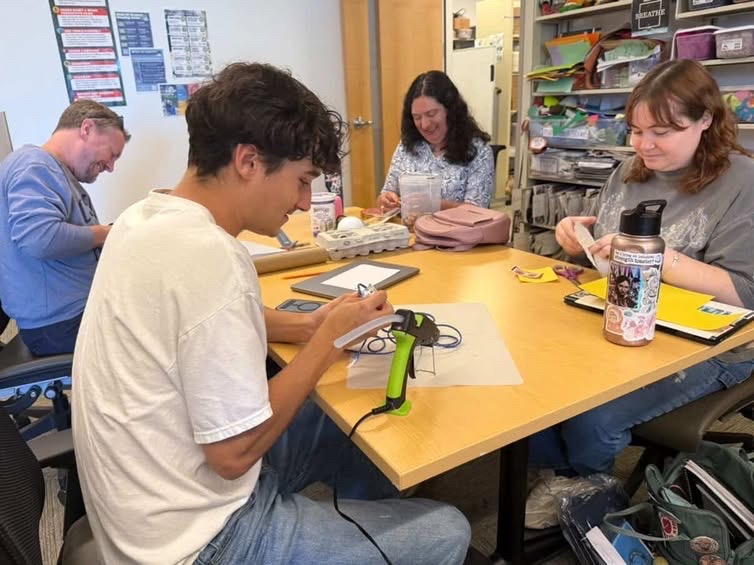
Around 15 students occupied the front tables of the Makerspace, as Martin and Gonzalez began the event with a PowerPoint presentation, starting with the connection between sustainability and upcycling. Reusing items creates a circular economy. Rather than creating new resources and throwing out usable materials, the materials are reused to keep them in the cycle of use.
“They make it really accessible to practice sustainability with the resources they have on campus. I have upcycled before and now I’m making some pipe cleaner flowers to put in this empty yogurt container,” said Sophia Carlson, a third-year global studies major.
A short discussion was held after that section of the presentation as students were asked what their families and themselves do that is sustainable. Students raised their hands offering methods such as compost piles, reusable water bottles and thrifting.
“And I’m really invested in sustainability, especially being so close to the ocean and wanting to keep the animals safe. My family’s very caring about recycling and composting and all that. So I thought, you know, why not? This sounds like a good way to get out and do stuff,” said third-year psychology major Shannon Hopper.
Gonzalez continued the presentation by defining Lo Rasqueache, “Something that looks a little different but still has value.” Stemming from the original term meaning, no value, that was reinvented through Chicanx artists. A form of upcycling that comes from making the most out of the least. An artform that was built out of survival became a form of expression and activism.
Once the presentation was through, students grabbed used objects, provided by Gonzalez, and started creating pieces with the help of supplies from the Makerspace. Crafting and chatting with their peers, students shared different examples of Lo Rasqueche in their community.
“Survival, I feel like it can take several different forms from, maybe I need to solve a problem at this moment that I don’t necessarily have all the standard supplies for so I’m gonna go ahead and use my ingenuity to come up with a solution and to survive,” said Gonzalez. “Oftentimes in Mexican homes, you’ll find a tin, and you think it’s cookies but it’s actually sewing supplies. And hey, these yogurt containers too are often used as Tupperware.”
Similarly, during the presentation a student explained how their grandma upcycles used and discarded Buzzballs they found into planters.
“I think what’s really cool too for students is that they see, at least in my classes they’ve seen this art around their homes and maybe not recognized it as art,” said Gonzalez.” Just kind of like something that your abuelita or your tia does, but really it is an art form, and there’s beauty in that art.”