

Since Valentine’s Day is right around the corner, we thought we’d start off February with a little romantic comedy collab. This week Eli read “People We Meet on Vacation,” while I (Hayley) watched the Netflix adaptation.
“People we Meet on Vacation” by Emily Henry was marketed as an opposites attract, friends to lovers, soulmates story that captured the slow burn chemistry between two life-long lovers. Instead, it was a boring, often painful showcase of how (sometimes) opposites truly do not attract.

Photo courtesy of Berkley Books
Never let it be said that the trope of opposites attract does not work. “Pride and Prejudice” by Jane Austen pulls it off beautifully, where the outspoken Elizabeth clashes and eventually falls in love with the reserved aristocrat Mr. Darcy. So does “The Love Hypothesis” by Ali Hazlewood: a popular contemporary romance where the brooding professor and bubbly up-and-coming researcher slowly fall head over heels in love. It just works. This book did not.
The story revolves around the main character Poppy and her best friend since college Alex. Poppy works for a travel writing magazine and – after needing some time off – decides to finally reach out to her long time, slightly estranged, best friend. Alex agrees to go on one of their legendary vacations (this time not sponsored by her agency) and so the plot unfolds.
Throughout the story there are numerous flashbacks to previous trips and experiences the two shared. The writing takes us on the journey of their budding romance, which in my opinion completely lacked any chemistry whatsoever.
Alex is up-tight and condescending, oftentimes being unresponsive to Poppy in her times of need. Poppy was always doing her absolute best to be as quirky as possible in a way that had me wanting to rip out pages.
Throughout the story one of the main plotlines is the argument they got into during their final vacation together, where they almost slept with each other. Afterward they split up and went their separate ways before their eventual union.
Ultimately, nearly every conflict in the novel hinges on avoidable miscommunication, turning what should be emotional tension into narrative frustration.
Poppy lies to Alex about their trip being funded by her agency, something she frantically tries to keep up, not wanting him to discover this is her attempt to fix their relationship. Alex lies to Poppy, claiming he is in a stable loving relationship with his on-and-off again ex. Even going as far as to say he was planning to propose to her. He wasn’t.
When it comes to the characters themselves they have little to no actual personality, besides the fact that they claim to be friends. Poppy showcases nearly no character traits at all throughout the book, except for in flashbacks when she seems to have more spirit than in the present day. Rather than feeling spontaneous or charming, Poppy’s attempts at quirkyness often came across as performative, like the personality itself was being used to substitute for genuine emotional depth of character.
There are moments in the story that should invite her to think introspectively or offer growth. Instead she defaults to deflection, which – as a protagonist – made it difficult to invest in her character arc.
To follow that up, the definitively stated reason that Alex is one of the most attractive men ever, is because he reads. That’s all. There is a small backstory with Alex about his mother who passed away and him taking care of his brothers. While I did like the direction it was going and the depth it brought to his character, it was never explored again and felt much more like an unrelated backstory point.
I am still forever a fan of Henry’s writing, and while her characters may at times lack there is still much to be said about her prose. Henry has written several great books, one being “Funny Story” which is my favorite romance of all time. Be that as it may there were still a few lines in this book that stood out to me.
“On vacation, you strike up conversations with strangers, and forget that there are any stakes. If it turns out impossibly awkward, who cares? You’ll never see them again.”
However this was not a book that could be saved with clever and thought provoking prose or the occasionally funny line of dialogue. With a title about meeting new people, or perhaps discovering oneself? I fear this book should have been called “Detailed vacations we took while having no communication skills and refusing to admit we want to be more than friends.”
In the end this read turned into one big miscommunication trope. With two characters who felt inherently selfish, and while deserving of each other, were not a story I would care to read again. This was a frustrating read with the occasional clever line at best, and I would give it overall a score of 1.5 stars. Along with that, for those who want to know, I would give this book a spicy rating of about 2, with a few intimate scenes toward the end.
With so much of the story’s emotional weight falling flat on the page, I am left hoping the movie can recover and offer the missing chemistry and maturity, or perhaps nuance that the novel lacks. So I turn it over to Hayley to see if the film fared any better.
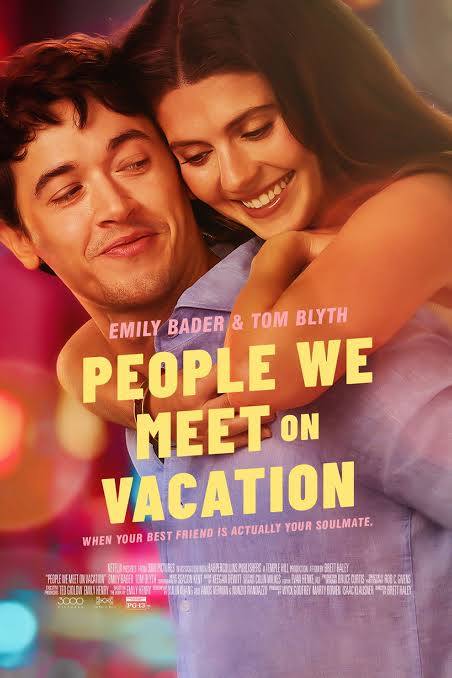
Photo Courtesy of Netflix
Opening with Eli’s favorite line, “On vacation, you strike up conversations with strangers, and forget that there are any stakes. If it turns out impossibly awkward, who cares? You’ll never see them again.” The movie started strong with some laughs and appeal to the character of Poppy (Emily Bader).
However, after watching the film with nearly a two-hour run time I’m wondering where all the time was spent? Or maybe it was just because the entire film was super predictable that as a viewer I was just waiting for the inevitable to happen, which felt like a bit of a drag.
Predictable, however, doesn’t always mean terrible. Especially when looking at romantic comedies, it often feels like it’s hard to escape the tropes of small towns, young messy love, and kissing in the rain…which this film has plenty of. That being said I did enjoy the way they chose to unfold the story, flashing back and forth between the current time and the past eight summers of the two love interests Poppy and Alex (Tom Blyth). This effect made me feel like I was going through the motions right alongside the characters, reliving emotional moments from their past that all lead them to this particular moment in the present.
Aside from the predictability, the other major issue I had from this film was the lack of stakes. The miscommunication between our love birds felt manufactured, necessary for the plot to carry-on but realistically didn’t make much sense. I also had to allow myself to believe in movie magic, and that the jobs these characters had paid them well enough to explore the world. Which isn’t the worst thing, a lot of us see movies to escape reality, but this was distracting enough I found myself wondering about the budget of all the summer vacations while watching.
One thing I think the film got right in comparison to the book is the likeability of the character Poppy. While Eli found her one note and annoying, the movie really made sure to make her relatable while still maintaining some of that quirky energy. The actress choice of Bader was perfect, and I look forward to seeing her in other roles in the future. Whereas the character of Alex was the flat character in the film. He had little to no dimension and, while Blyth played him well, I wish the movie gave him just as much intrigue as they had with Poppy.
With its made for TV charm, I feel this film was fine. It could be a solid choice to play during a Galentines night, or if you are stuck at home around the fourteenth and want a feel good film with really low stakes. On the Hayley’s Hot Takes spicy scale this gets a low 2, followed by the question of who were the people they met on vacation? Because I certainly don’t recall any.
Stay tuned for next week as Eli and I both dive into some better options to read and watch around Valentine’s Day.