

A thick cloud of despondency filled the theater as the credits rolled for “Die My Love.” That sinking feeling in my chest seemed to affect not only myself, but the entire audience as we gathered ourselves to walk out of the theater. That proved to me how impactful and successful this movie was at conveying its story.
The movie starred the long awaited duo of Jennifer Lawrence as Grace, with Robert Pattinson as Jackson. This young couple from New York move into a fixer-upper farmstyle home in the south that had belonged to Jackson’s uncle before he died by suicide.
We watch the couple go from a passionate, primal sort of love to new parents quickly, with both seeming unsure how to adjust to the new shape of their family. For Jackson, it seems he can’t shake his dreams of becoming a musician and working on the “road” nor alcohol. Grace is coping with feeling unfulfilled and undesirable to Jackson, as if she’s been put into a box of motherhood and that any other facet of her identity and needs are no longer noteworthy.
This film is adapted from the 2012 drama fiction novel “¡Maldito amor!” by Ariana Harwicz (which translates from Spanish to “Die, My Love”)
I couldn’t help but notice the film had many themes, plot points and direct connections to another well known short story, “The Yellow Wallpaper” (1892) by Charlotte Perkins Gilman, starting the moment the film opens on the couple entering their new home with yellow floral wallpaper to the yellow hues that overlaid the film like a filter.
The parallels, however, don’t end there as we come to learn Grace is a writer, much like the female narrator of the “Yellow Wallpaper” who has to hide her writings from her husband. Grace’s behavior and that of the female narrator parallel each other. Both destroying the wallpaper, scratching it with their fingers until they bleed and crawling around animalistically in the home’s tall grasses. Also, the male love-interests in each story both try to handle their mentally ill wives in a manner that shows they aren’t sure how to help or to love, but they will attempt to do what seems to be the best answer to them.
Despite its parallels to other stories of mania, some differences that really made this film stand on its own in an incredibly modern way were the way they used the female characters, the sound design and their approach around Grace’s relationship with her son.
The dynamic between the other women in this film and Grace brought another modern concern to this film. I encourage the audience to try and see when any of the female characters ever choose to support one another in their struggles. Grace was failed all around by the women in her circle, so it would seem. Until perhaps the very end- but I will leave it up to you to decide if it was too little too late.
Grace didn’t reflect the stereotypical signs of postpartum depression, another thing done in contrast to the “Yellow Wallpaper.” Instead, she had zero issue taking care of her son, often acting with maternal instinct. Something that I think Gilman was making commentary on was the lack of knowledge around women’s mental health, especially regarding postpartum depression, of the medical field in the eighteenth century. Whereas in our current time, we use the idea of postpartum depression as a scapegoat, used to disregard a struggling new mother’s mental health journey. As displayed by this film, this idea can be ignorant and dismissive to what is really going on in a woman’s life.
I believe Lawrence captured this perfectly, not only in her depiction of a nurturing gentle mother, but also within her relationships with other characters. Soothing her husband, his sick father and her mother in law, she showed up in undeniably nurturing and intuitive ways for them all. In turn it makes it even more heartbreaking when she’s disregarded and shoved into a box and labeled in a way that she didn’t quite fit. A remarkable performance from Lawrence, exhibiting incredible emotional depth, acting that shouldn’t come as a surprise to anyone who has seen her in other films like “Mother” and “Causeway.”
A lot of the movies I discuss go into detail about the sensory experience. However, this film particularly used sound to its advantage by letting the audience into Grace’s headspace. Through uncomfortable sound design, like a dog ceaselessly barking and whining, a fly buzzing and children’s music playing on a loop to really get you as uncomfortable and uneasy as Grace herself.
“Die My Love” also played into moments of silence, where there wasn’t noise in the background to give not just give Grace relief but also us. This drove the sensory experience over the edge in a very successfully immersive way, and had the audience mirroring the emotions of Grace: when she sighed in relief, so did we.These sort of immersive details had the audience sympathetic to Grace quickly despite not truly understanding her plight or having our own reasons to resonate with her.
All in all, this film gets a 5 out of 5 for a sorrow-filled spicy take. I can’t picture a world where Lawrence doesn’t win an award for her acting in this one. “Die my Love” is playing in theaters now, and trust me when I say this is not one you want to miss seeing in the cinema.
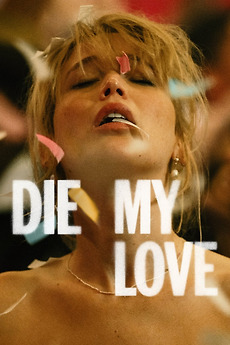
Photo courtesy of Black Label Media