
The $2.5 million used for the new fitness facility at Cal State Monterey Bay (CSUMB) didn’t come from state funding or student tuition. It came through the University Corporation – a non-profit organization that receives money from the rent and meal plans that students pay for.
UCorp also was a big financial contributor to the new science and engineering building going up on campus.
And the Ottermobile, the new food truck that makes the rounds on campus? Yep, that funding came through UCorp as well.
Whether or not most students are aware of it, University Corporation (UCorp) makes decisions about key aspects of their lives, including housing and dining.
“There’s not enough money coming in from tuition and the state to pay for everything [students] experience,” says Jill Hosmer-Jolley, a former faculty representative for UCorp’s Board of Directors. She adds that auxiliary organizations like UCorp are essential to an efficiently operated university.
UCorp defined
According to Alan Fisher, interim executive director of the University Corporation and chief financial officer at CSUMB, the Corporation is a 501(c)3 non-profit organization designed to, “lend support to the university and to enhance the student experience in ways that the university either can’t do in terms of financing or falls outside of what the university’s mission and overall expectations are.”

To fill the gaps that state funding and tuition don’t cover, public universities such as CSUMB must create auxiliary organizations like CSUMB’s UCorp and University Foundation. All 23 California State Universities (CSU) receive support from auxiliary organizations similar to those of CSUMB.
While the purpose of the University Foundation is to receive donations, it is the University Corporation, which handles business enterprises on campus – things like housing and dining – that students are more likely to interact with on a daily basis.
In addition to these services, UCorp also operates CSUMB’s radio station KAZU, the Child Care Center, the Salinas City Center, CSUMB’s bookstore, grants, the Otter Student Union and various accounting and human resource services on campus.
Your housing and food
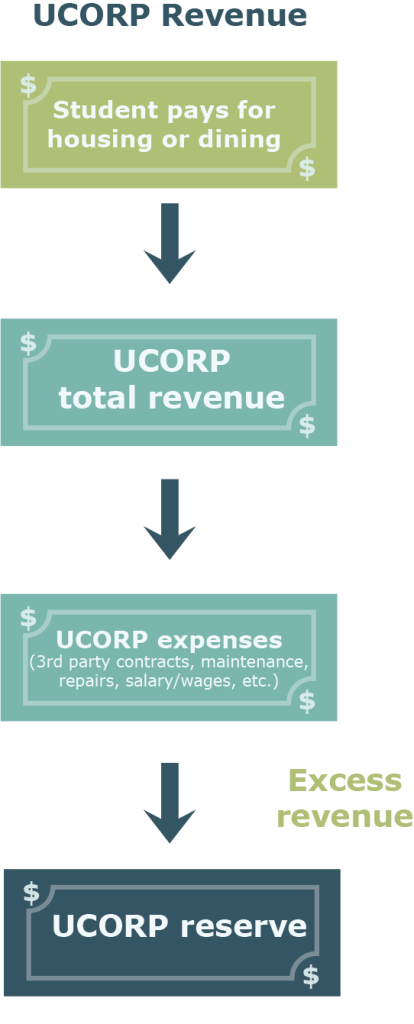
The Corporation operates certain services like housing and dining by contracting them out to third-party providers like Greystar and Chartwells respectively. By contracting out these services through the Corporation, the University can avoid becoming mired in the many bureaucratic and budgetary restraints involved in utilizing state funds, allowing the University to “run them like a business instead of like a government agency,” Hossemer-Jolley said.
After the third-party providers get paid from housing and dining revenue, and operational expenses are paid within the Corporation, the remaining funds go into UCorp reserves which, “goes right back into upgrading things [on campus],” said Ben Corpus, vice president for Enrollment Management and Student Affairs. As of June 30, there was $50,611,331 in the Corporation’s reserve.
Who decides?
Decisions like which businesses to sign contracts with and how to use the reserves are decided by the Corporation’s Board of Directors, which is made up of three administration members, a member of the community, a faculty representative and a student representative. It is overseen by Vanya Quiñones, CSUMB’s president.
The Board consists of:
Vanya Quiñones: Board President; CSUMB President
Alan Fisher: Interim Executive Director; Interim Vice President of Administration and Finance; Chief Financial Officer of CSUMB
Andrew Lawson: Secretary/Treasurer; Interim Provost; Vice President of Academic Affairs
Robert Taylor: Community Member; Attorney at Law
Ben Corpus: Vice President for Enrollment Management and Student Affairs
Arlene Haffa: Faculty Representative (formerly Jill Hosmer-Jolley)
Andrew Nino: Student Representative
Each board member has an equal vote, with Quinones a non-voting member. While smaller decisions are often delegated by Fisher to UCorp staff, bigger ones, “like the overall expenditure of $1 million,” require a majority vote from the Board, Fisher said.
“Because the University is on a very finite budget, when some kind of an expense comes up that the state can’t afford to do, they will oftentimes turn to the Corporation,” Fisher said.
For example, CSUMB is currently exploring the possibility of converting Gavilan Hall, Building 201, into dormitories. Fisher estimates that just to do preliminary assessments of the project’s feasibility could cost upward of $1 million.
“That’s $1 million that the university does not have,” Fisher said.
“All 23 [CSU] campuses are competing at the same money [to construct] more buildings and that’s where the [Corporation’s reserve] comes in handy,” Maddison Burton, interim associative executive director said.
How decisions are made
Some have wondered if resources are so limited, what the rationale was behind projects like the $2.5 million fitness center, which opened in September, or the $80,000 Otter Mobile food cart.
According to Fisher, expenditures like these are “a balancing act,” between investing in improvements to the campus that will affect a particular population of students versus those that will affect the student body as a whole. This was the case with the fitness center, which was part of CSUMB’s master plan but was delayed for years due to insufficient funding.
“With the workout facility, every student on campus is not going to participate in that but there are students who will utilize that and it enhances their student experience,” Fisher said.
The Otter Mobile on the other hand was purchased in response to complaints about poor access to food in certain parts of campus.
Are there ways in which students would rather see the reserves being used?
“We’re here to listen,” Fisher said. “None of these decisions are ever made in a vacuum. The University and the Corporation get as much input from students [as possible]…so that we can make decisions that are relative to what student needs are.”
In addition to getting involved with various forums such as the Housing and Dining Committees or Associated Students (AS), according to both Fisher and Burton, the most effective way for students to make their voices heard by the Corporation’s Board of Directors is to get in touch with the student representative, Andrew Nino ([email protected]).
While Nino, a second-year business major, only began his position on the Board in July, he is also the vice president of Financial Affairs for AS where he is involved in working with the AS budget and, according to Fisher, “has no problem asking us questions and representing [the students].”
Nino encourages students to learn more about how the University Corporation operates.
“All the information for the Corporation as well as the Foundation is completely accessible online. Nothing’s hidden,” Nino said.
“If [students] want to know more about the Board of Directors, Corporation or Foundation, they can reach out to me…I would love to hear more from students.”