
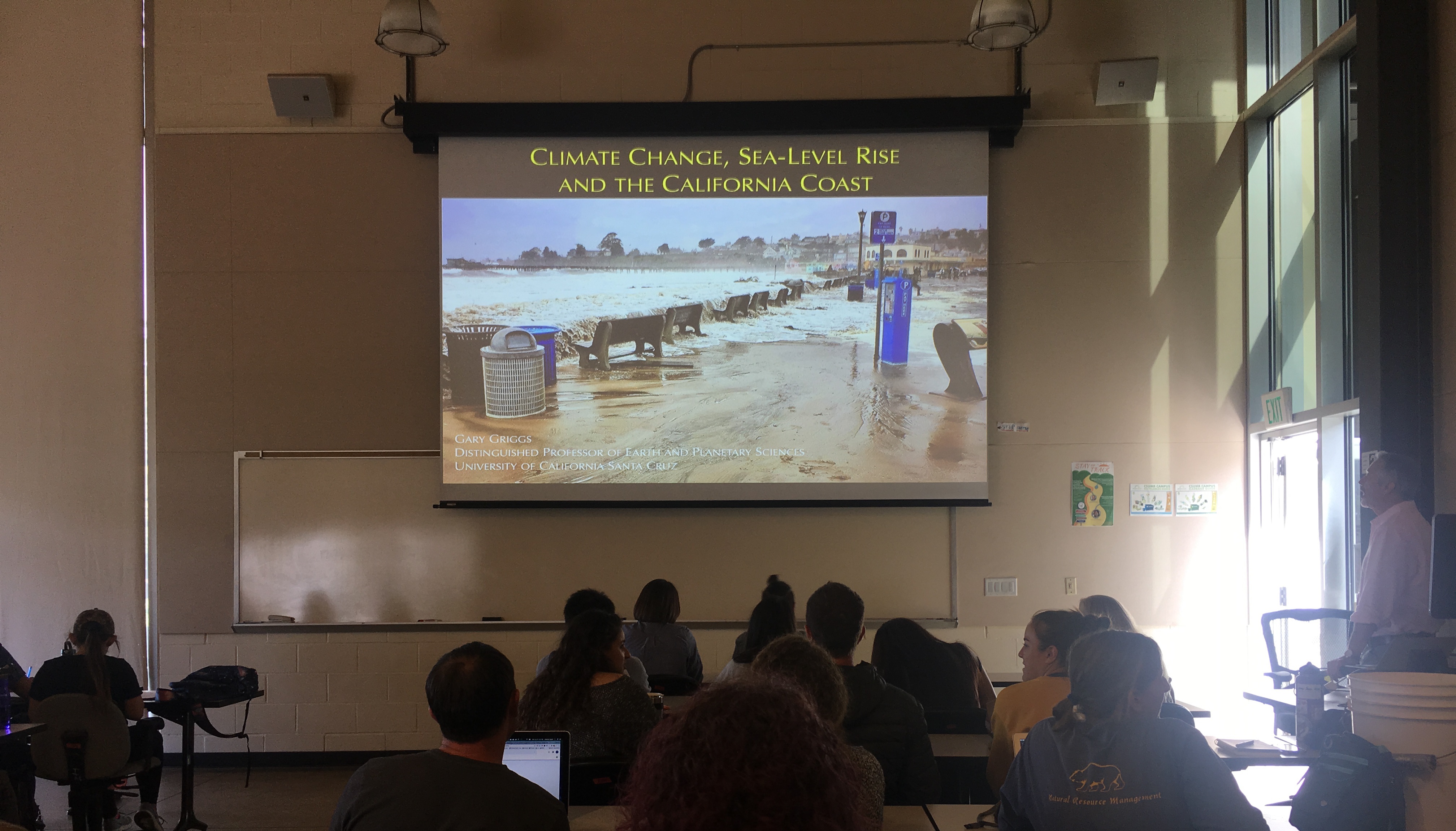
Local scientist Gary Griggs delivered a century’s worth of climate change research, including his own, in under an hour on April 9. From University of California Santa Cruz, Griggs is a distinguished professor of Earth and Planetary Sciences. Dr. Griggs opened the presentation by highlighting the recent event in which the cities of San Francisco and Oakland filed suit against multiple oil companies for damages caused by climate change.
The cities claim that the oil companies are responsible for climate change, and therefore should be responsible for the reparations of the damage. Three leading experts on climate change were called in to advise the court, one of whom was Dr. Griggs. Underneath Griggs’ charts and studies, he had a simple message for the court—and for the rest of us: “The shoreline is moving. It is moving toward us. And it is moving because of climate change. Those are the facts whether you’re a Democrat or Republican. Those are the facts whether you believe them or not,” said Griggs.
While this may seem like a bold statement, Griggs backed it up with vast amounts of empirical data and models that were presented in an easy to understand format. Climate history is recorded in sediment, ice, tree rings and deep sea corals. The most significant data are CO2 levels measured from Antarctic ice cores.
This data allowed scientists to deduce that throughout history, Earth experiences heating and cooling in 100,000 year cycles. The peak of each heating cycle roughly corresponded with 300 parts per million CO2in the atmosphere until very recently. Decades of monitoring at Mauna Loa Observatory tracked this unprecedented spike in CO2 to 900 ppm in the last century.
Approximately 44 percent of this CO2 is accumulating in the atmosphere, aiding in the well-known Greenhouse Effect. Warming temperatures mean melting ice, which gets to the knitty gritty of Grigg’s presentation. Sea levels are rising, and while this is nothing new, coastal cities can’t adapt the in the way a natural coastal environment could. New York City certainly can’t relocate itself.
Dr. Griggs pointed to the importance of short term events. Now isn’t the time to debate whether climate change is real. Rather, it is time to respond to the events affecting lives right now. Coastal properties are at risk, and so is the security of citizens who live in the surrounding coastal areas. With more than half of the world’s population living in coastal regions, citizens and authorities alike must decide on a course of action: “Mitigation, adaptation, or denial.”
Recent El Niño years in California, and Hurricane Irma to the East have perfectly demonstrated the futility of building whole societies near the ocean—just to have them torn down time and again. Each event worse than the last. Even the California Coastal Commission has caught on, now strictly restricting and regulating coastal development.
Scientists are increasingly taking on the role of outreach. Dr. Griggs is not only versed in decades of climate change research; he has taken it upon himself to communicate the relevance and urgency of this information with the wider public. SNS seminars are held on Mondays from 4-5 in the Chapman Science Center, room E104. Each seminar is an opportunity for Otters to network and learn about the contemporary research taking place.