
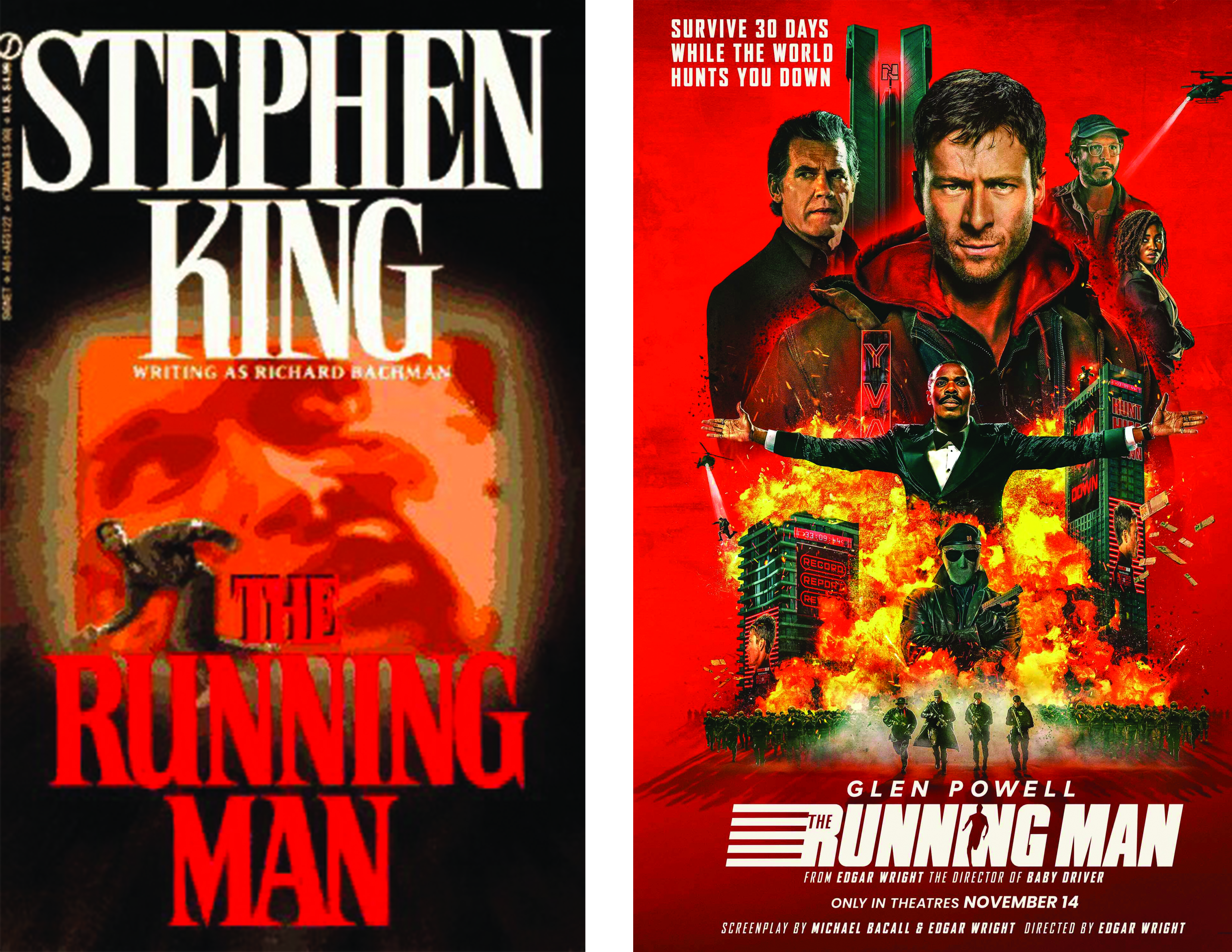
This week, Hayley of Hayley’s Hot Takes and I (Eli, columnist of the Reading Raft) are tackling “The Running Man” story from all sides: the 1982 Stephen King novel, the original 1987 film adaptation and the newest blockbuster “The Running Man” (2025). With three versions spanning more than four decades, each brings something different to the table. Let’s walk before we run and start off with the original text.
Going into “The Running Man,” I wasn’t sure what to expect. I’ve never been shy about my mixed, often negative feelings toward King: I can recognize his talent, but his character choices and writing style often leave a sour taste in my mouth. That’s why I was surprised by how quickly this book pulled me in.
Set in an alternate timeline 2025, “The Running Man” (1987) paints a dystopian future where the masses are numbed by screens and a mega corporation known only as “the Network” has near total control over society. The network creates shows and entertainment to placate the public that usually come in the form of sadistic games where contestants risk humiliation, mutilation and often death to hopefully earn enough money to survive.
The most extreme of these is The Running Man, a show where one contestant has 30 days to evade a nationwide manhunt, spearheaded by a team of hunters given nearly infinite resources by the Network. If they survive, they win a billion dollars. The catch? The record for survival is 8 days. The story follows Ben Richards, who enters the game out of desperation to afford even the most basic medication for his 18-month-old daughter, who is dying of pneumonia. During his desperate struggle for survival, many of his closest friends, people along the way and much of the network go down in a blaze with him.
What stands out most is the pacing. The book is relentless, and King writes fear, exhaustion and desperation with vivid clarity. You feel exactly as Richard does, heart pounding, hiding in a sewer beneath a boiler you just set to explode, skin burning as you huddle against the heated metal of the grate. It’s a world that feels hopeless, but never flat. Richards’ emotional and psychological spiral, the grim knowledge that he’s unlikely to survive, paired with the relentless drive to keep going kept me invested the whole way through. The tension works. The adrenaline works. And despite my reservations, I found it genuinely compelling.
But enjoying this book doesn’t mean ignoring its faults. King may be one of the most prolific writers of popular fiction, but his work, especially from the ‘80s and early ‘90s when King wrote under the alias Richard Bachman, often reflects the worst aspects of that era. The casual use of racial and homophobic slurs along with the sexualization of women, is tiring and unnecessary, and at times pulled me out of the story completely. Some might argue “it’s just how people talked back then” (as is often done for writers like King) but I don’t think this excuses it. The writing and the writer are connected, and the consistent choices he makes on the page reflect more than just a desire for realism.
Hayley cutting in here, I went and caught “The Running Man” film adaptation in theaters on opening night. While it seems to have followed the King novel pretty closely in plot, it definitely faltered in capturing the same haunting and gruesome theme. Instead, it pivots to frame Ben Richards as our next modern-day hero.
In my cinematic journey this week, I also found myself watching the 1987 adaptation of “The Running Man,” which, despite stretching even further from the novel’s plot, seems to be far more near and dear to the audience of that time’s hearts than the latest adaptation.
So where did this latest film go wrong? In short, it can be summarized by two things, the acting and the modernization. Glen Powell is our Richards, a supposedly anger-riddled new father who ends up on this show to win “new” money to help afford medication for his daughter and escape living in the slums. Sounds familiar, right? However, Powell doesn’t really deliver anger, sarcasm most definitely, but his portrayal of an angry, determined father came off as super unserious to me. It felt like, instead of pulling inspiration from the novel, Powell was given instructions to model his version of Richards off the veteran American hero Richards, whom Arnold Schwarzenegger played in the 1987 film.
This story, as Eli mentions, is meant to be set in 2025, which for the 1982 novel and even the 1987 film, makes total sense, with both predicting a dystopian version of the future. This didn’t work well for our current adaptation, since we are already in the year 2025, yet the film added futuristic elements to the story. Likely to poke fun and fear into our current society, but it didn’t really work for me. It felt like they weren’t sure what genre they wanted this film to be and instead blended social criticism, comedy and the hero archetype together in a way that just didn’t land.
“The Running Man” 2025 gets a 2.5 out of 5 for me. Worth a watch if you are a die-hard King fan or have kept up with all the other adaptations of his novels that have hit the big screen this year, like “The Long Walk” and “The Monkey.” Otherwise, stick to the novel, or even spend some time at home watching the 1987 version before running out to the theater.
Eli here to round us off, across both the book and the film adaptations, “The Running Man” is a story about societal powers, spectacle and survival. The novel takes an approach that is sharp, fast and more unsettlingly violent. As Hayley said, the latest film contrasts this with a more modernized action hero story, coming at the cost of the grit of the original. Overall, I would give the original novel 3 stars. I enjoyed the storytelling and plot; however, I am reminded why I have a complicated relationship with Stephen King’s writing.