
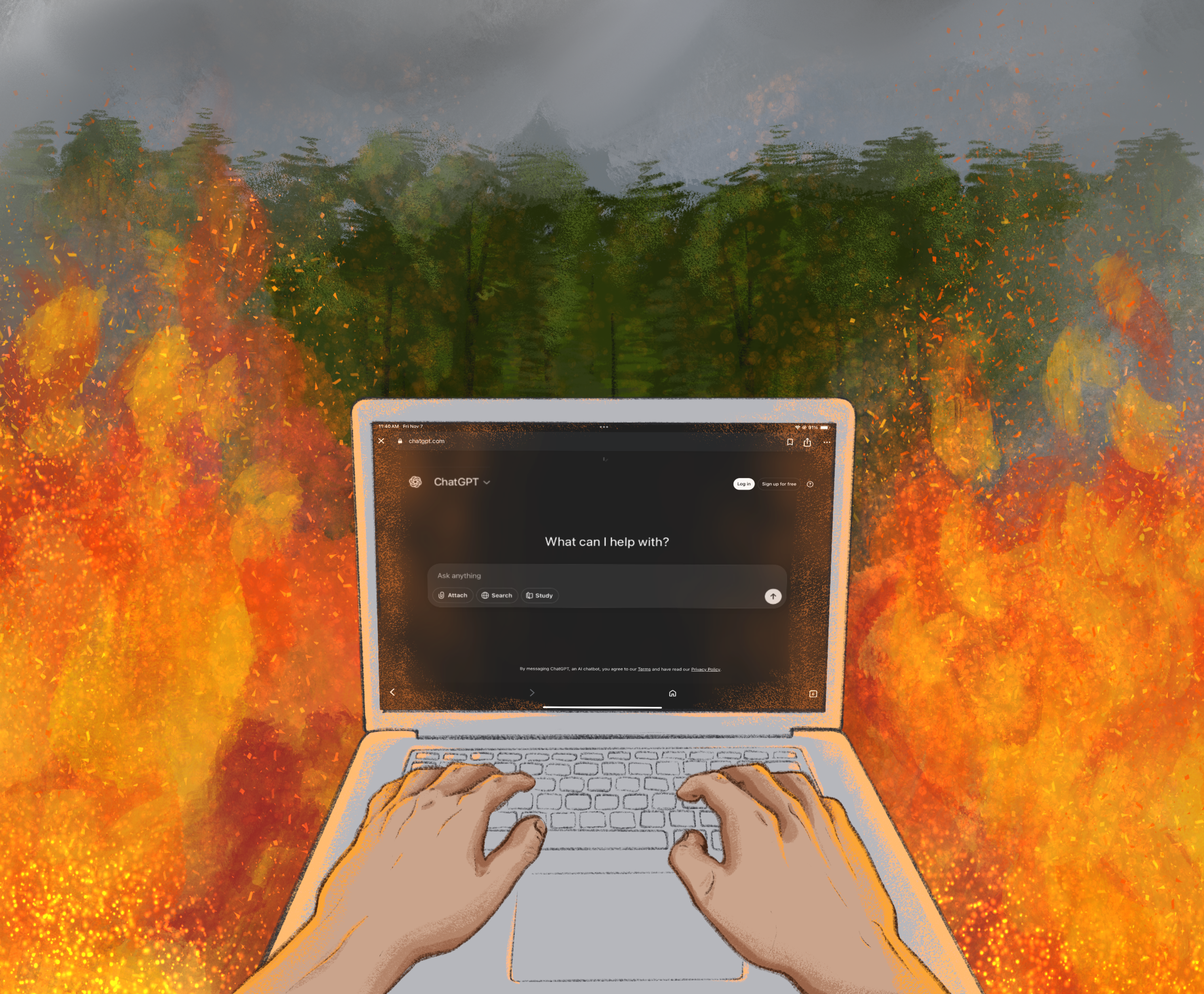
Every time you ask ChatGPT to answer a question, help you with an assignment or generate an image, you’re setting in motion multiple operations that tax the environment.
Using ChatGPT, which is currently on every Cal State Monterey Bay (CSUMB) student’s dashboard, consumes about five times as much energy as a simple Google search.
Data centers also require large amounts of chilled water to cool down the computing equipment for artificial intelligence (AI). Scientists at the Massachusetts Institute of Technology (MIT), who have documented these environmental impacts, have estimated that for each kilowatt hour of energy a data center consumes, it would need two liters of water for cooling.
Yet, at CSUMB and the other 22 California State University (CSU) campuses, AI use is encouraged as the system tries to prepare its students for the rapidly changing job market.
In February, a partnership between CSU and OpenAI was announced in a systemwide email sent by CSU Chancellor Mildred Garcia. This partnership was characterized by the system as a “first-of-its-kind public-private initiative to establish the CSU as the nation’s first and largest AI-powered public university system to serve its entire community.”
According to the email, this initiative positions the CSU as a global leader among higher education systems in the “impactful, responsible and equitable adoption of artificial intelligence.”
But some wonder, at what cost?
“We already have a climate change problem that is not being addressed quickly enough. AI is adding to that in [numerous ways],” said CSUMB Applied Environmental Science Professor Tori Derr.
Derr feels AI is “horrible.”
Environmental impacts
According to MIT, the rapid development and deployment of AI have environmental consequences, including increased water consumption and higher electricity demand.
Training AI software requires immense amounts of energy, which ultimately leads to increased carbon dioxide emissions and puts pressure on electric grids. Data centers are dealing with high energy demands to train tools like ChatGPT, causing it to be a major factor in AI’s environmental impacts.
Scientists have estimated that the power requirements of North American data centers have increased from 2,688 megawatts at the end of 2022 to 5,341 megawatts at the end of 2023, largely due to the demands of generative AI, according to MIT.
These large amounts of power needed to train and deploy models like OpenAI’s GPT-3 are hard to attain. Scientists estimated that training processes alone consumed 1,287 megawatt hours of electricity, which is enough to power about 120 average United States homes for an entire year. This amount of power also generated about 552 tons of carbon dioxide.
Campus response
“It is absolutely apparent that AI is more harmful to the environment than doing just a web-based search or writing an email or any of the other things you would use a computer or a phone for,” said Derek Martin, the associate director for Safety, Risk & Sustainability at CSUMB.
“So based on that, I think it’s worrisome, but it’s worrisome in terms of how it’s being used.”
But Martin recognizes that AI isn’t going away.
“I view AI as a tool. Just like any other tool, it can be used for good and it can be used for bad. And it’s never used one way or another,” Martin said. “It’s a combination of both.”
Martin thinks that guidelines on responsible AI use are needed and are hopefully being produced by the sustainability office in the future.
“AI has been unleashed into the world with very little, I think, societal understanding of what that meant until it was already here. So there is no opportunity for us to go back in time and undo it. Now society is grappling with this in real time, as we’re still learning more and more about it,” he said.
How CSU views it
When the Chancellor’s Office was asked about the sustainability question last month, a spokesperson responded, “The environmental impact of AI is an evolving area of study, and CSU is closely monitoring emerging research while integrating sustainability into our digital strategy. We remain focused on responsible computing: using efficient data centers, renewable energy, and sustainable procurement practices. CSU is committed to balancing innovation in AI with our system-wide sustainability goals.”
According to the New York Times, this collaboration is the world’s largest rollout of ChatGPT to date. The CSU also has an AI committee, which includes representatives from large tech companies, to help identify skills California employers are looking for to increase students’ career opportunities.
Documenting damage
Measuring the university’s AI usage is currently not possible. CSUMB is focusing on its three sustainability goals while trying to reach carbon neutrality for categories known as scopes. The university is focusing on Scope 1 and 2 to accomplish carbon neutrality.
Scope 1 emissions are things that are combusted on campus. These include the natural gas-fired boiler that heats campus buildings and water. This gas is combusted on campus, categorizing it into Scope 1.
Scope 2 emissions are utilities, mainly purchased electricity. Some 15% of the university’s electricity comes from solar panels on site; the other 85% of the electricity comes from off-campus. There are carbon emissions associated with producing the electricity purchased and its subsequent use.
Scope 3 is where AI usage from the university would fall under. These are not necessarily controllable variables, such as business travel, waste produced, goods and services consumed, or things like faculty, staff and students.
“That’s where our AI use is going to be coming from. Through those data centers somewhere else that are churning out our AI searches,” Martin said. “So our scope 3 emissions go up, but that’s not in scope 1 or 2 for our carbon neutrality goal.”
“[Our AI use] is not affecting that goal, but it certainly is affecting the nature and spirit of what we’re trying to accomplish here,” said Martin.
AI in the classroom
AI is booming and growing more quickly than the planet can adapt, according to Derr. She discussed how, without a physical or visual consequence caused by AI, users are unaware of its impact.
“We’re going to move forward with [AI use] and we’ll solve those problems later, but we don’t have that luxury anymore. We haven’t had it for a long time.”
Derr said that professors aren’t necessarily being encouraged to use AI, but “AI Sandbox” sessions have been offered to the College of Science. These are opportunities for professors to share experiences with AI use and learn new tools. “We’re not having a similar space for other pedagogical tools or approaches,” said Derr. These sandbox sessions focus solely on AI, and there haven’t been any formal opportunities like this.
While it seems like this partnership is something all teachers will have to use, this is not the case. Derr said, “Faculty actually own their teaching. We can have, as a program, decisions that we make, but those are made by the faculty. No one can tell us what to teach or how to teach them.”
“This is a touching point with AI because they’re saying ‘we’re doing this’ but that’s getting into pedagogy – that’s getting into how we teach,” said Derr.
“People choose the more convenient and easier thing. I worry that’s what we’re going to be doing more and more and that AI is going to become our default. People don’t think about the intensity of the amount of carbon that we’re emitting, the amount of land that’s changing around the data centers, the amount of water that’s being used, all those things,” said Martin.
“So that’s my worry. I think it’s a great way to help people do more in their jobs. But the environmental impacts add up quickly.”