
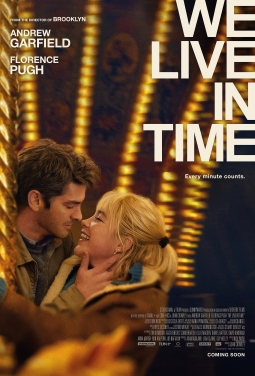
In our lives, we’re often remembered not for our achievements but for the small, sentimental moments that carry on past ourselves and into the hearts of our loved ones. Director John Crowley captures this sentiment beautifully in his new film “We Live in Time,” a film that might make you swap your popcorn bucket for a tissue box and leave the theater reflecting on your own life and how you wish to live it.
We’ve all heard the phrase “less is more,” but this film’s lesson is that less can be enough – it’s often the little moments in life that we all value and remember more than the larger achievements in life. Given the choice to either once again battle her returning cancer, or live out the terminal diagnosis without having to deal with the side effects of chemo treatment, which may or may not work- Florence Pugh, portraying Almut, brings this struggle to life. Showing the audience how hard it is to cherish these small moments when faced with the reality of running out of time and how hard it can be to make these hard decisions, not only for herself but also knowing her choices affect her family.
Crowley’s decision to direct a film through a non-linear order, time-jumping, perfectly encompasses the feeling of reflection. The audience pieces together the journey of Almut and Tobias (played by Andrew Garfield) through flashes of memory – illustrating rather than telling, which moments would be the monumental ones, even if the characters didn’t realize it.
These time jumps give us a limited, fragmented view into the characters’ lives, avoiding the typical linear narrative we often follow. Instead, we’re treated to glimpses of the couple’s core memories, creating a nostalgic feel. Cozy settings like Almut’s apartment and a family cottage, add warmth, drawing us into the authenticity of these characters and connect with their completely ordinary lives.
Another standout element of the film is its departure from typical gender stereotypes, with an uncommon role reversal in American romance films. Garfield’s character is sensitive, gentle and the more submissive partner. I, Hayley, found this choice super refreshing. It felt authentic and made the intense, emotionally charged moments feel entirely genuine and vulnerable.
Personally, I, Francine, connected with Almut in so many ways that the film hit me harder than I expected. Her quiet moments of fear and strength mirrored my own experiences, as I imagine they might for many women. There’s something powerful about seeing a character who reflects your most vulnerable parts on screen.
Both Hayley and I appreciated the film’s honest portrayal of a character coming out of remission, a real fear for many cancer survivors. This storyline adds depth, steering away from the usual feel-good romance to something closer to real life– messy, bittersweet and without guaranteed happy endings.
Ultimately, “We Live in Time” is a powerful reminder that life isn’t measured by grand achievements but by the small, meaningful moments with those we love. Through emotional storytelling and reflective time jumps, the film encourages us to live in the present, even when the future feels uncertain or scary. As Tobias admits, “I’m guilty of looking ahead instead of right in front of me, at you,” reminding us that the most important moments are happening now.
With its emotional depth and captivating performances, “We Live in Time” is sure to leave you in tears– just as it did us. It’s a heart-wrenching and thought-provoking film that earns a tearful but well-deserved 4.5 stars.