
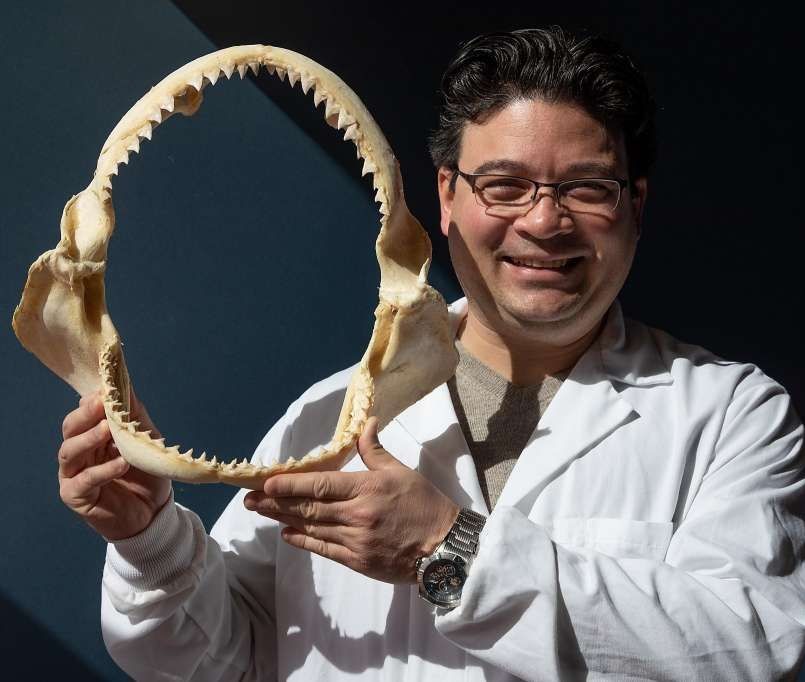
In February, a band of dedicated and brilliant scientists – among them was our very own Assistant Professor of Natural Sciences Nathaniel Jue – worked tirelessly together to complete a genetic profile on the notorious great white shark, a task that, until now, was never done. While the actual task of completing the genetic profile was a noteworthy feat in itself, what was significant was what that profile was able to tell them: one of the ocean’s most feared predators also had an impressive, natural resistance to cancer.
“What we found was that [great white sharks] had these signatures of really highly molecularly adapted proteins related to things like DNA repair, responding to DNA damage and even scheduled cell death,” Jue said. “This is important because if a damaged cell is allowed to persist, that’s how we get things like cancer. A shark has evolved to come up with a way to deal with that. The technical term for it is apoptosis.”
Jue was quick to point out that this was surprising in the scientific community, as it was once thought that animals that were larger than humans were more susceptible to getting cancer. However, when taking a gander at another large cartilaginous fish, the whale shark, it produced the same result – the gentle giant is a stranger to cancer.
“Animals like the great white shark or the whale shark … are large animals that live a long time – typically 70 years or so. Humans have a big genome, but their’s are bigger than ours, meaning they have a lot more cells and more DNA, but we don’t see the same sort of incidences of genetic disorders like cancer like we see in ourselves.”
Jue says a great white shark’s secret to keeping cancer at bay are what he calls “repetitive elements,” that are naturally occurring viruses that affect an organism’s genome. In white sharks, they have many copies of a specific repetitive element that’s evolved to respond to genetic issues quickly and effectively.
What’s significant about these findings is that now we’re able to compare the genome of the great white shark to that of humans, look at how the proteins responsible to cell and DNA repair respond, and why we’re more susceptible to getting cancer.
“If we’re able to understand what it is about the system of a great white shark and how it’s so resilient to cancer, it paves the way for us to understand our own system – and the more we understand, the greater chance there is to make giant leaps in treatment. All it takes is a better understanding,” said Jue.