
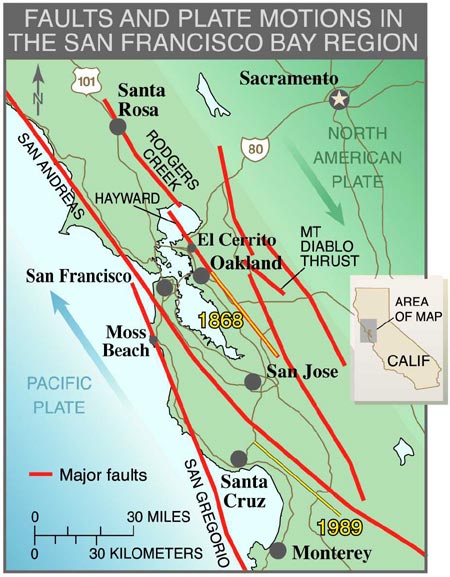
Two earthquakes, happening just a day apart, shook the San Francisco Bay Area in more ways than one last month. The epicenters of these quakes both occurred along with the Hayward fault, which has been described by experts as a “tectonic time bomb.”
The Hayward fault is particularly dangerous, arguably even more so than the feared San Andreas fault, for a few reasons. An eye-opening report by the U.S. Geological Survey estimates that a significant earthquake, such as a magnitude 7 quake, could have an initial death toll of at least 800, which would increase due to the likelihood that “more than 400 fires could ignite” following the quake.
The Hayward fault runs through the eastern, most densely populated region of the Bay Area, putting as many as 2 million people at a high risk. The fault typically sees a major earthquake “once every 150 to 160 years, give or take 70 or 80 years,” according to the report. The last major earthquake, a magnitude 6.8, occurred along the faultline 150 years ago. While there is no guarantee that a major quake will hit within the next few years, many became especially concerned about the risk after the smaller tremors hit the Bay Area.
The Loma Prieta earthquake, which occurred in 1989 in the Santa Cruz mountains, stands as an example of how far the reach of earthquakes can be. Although this quake did not occur along the Hayward fault, it had effects on both the San Francisco Bay Area, as well as the closer Monterey Bay area. Noting this begs the question: how would the Monterey Bay area, a region many of us call home, be affected if the Hayward fault or another fault had a “big one?”
“While we do have the San Andreas fault practically in our backyard here in Monterey Bay, we also have the San Gregorio, the Calaveras and the Hayward faults too,” explained David Minovitz, an environmental science professor at California State University, Monterey Bay (CSUMB), “There’s a whole zone, [so] we’re kind of caught in a vice right here. The Loma Prieta Earthquake in 1989 was a reminder to Monterey Bay residents of the continued movement of North America alongside the Pacific plate at about 1.5 inches/year. It was a reminder that we are living in a beautiful, yet seismically active area. There are actually hundreds of earthquakes in the central coast everyday, most of which we don’t even feel.”
The thought of a significant earthquake can be troubling for many, however, “I don’t think Monterey residents need to be worried about earthquakes on a daily basis. More people die from driving on the freeway,” Minovitz concluded, “but it is important to learn about the long history of natural disasters in this part of the world. There have been earthquakes not far from CSUMB, and there will be lots more to come, in our lifetimes or beyond.”